RC Airplane Radio Basics
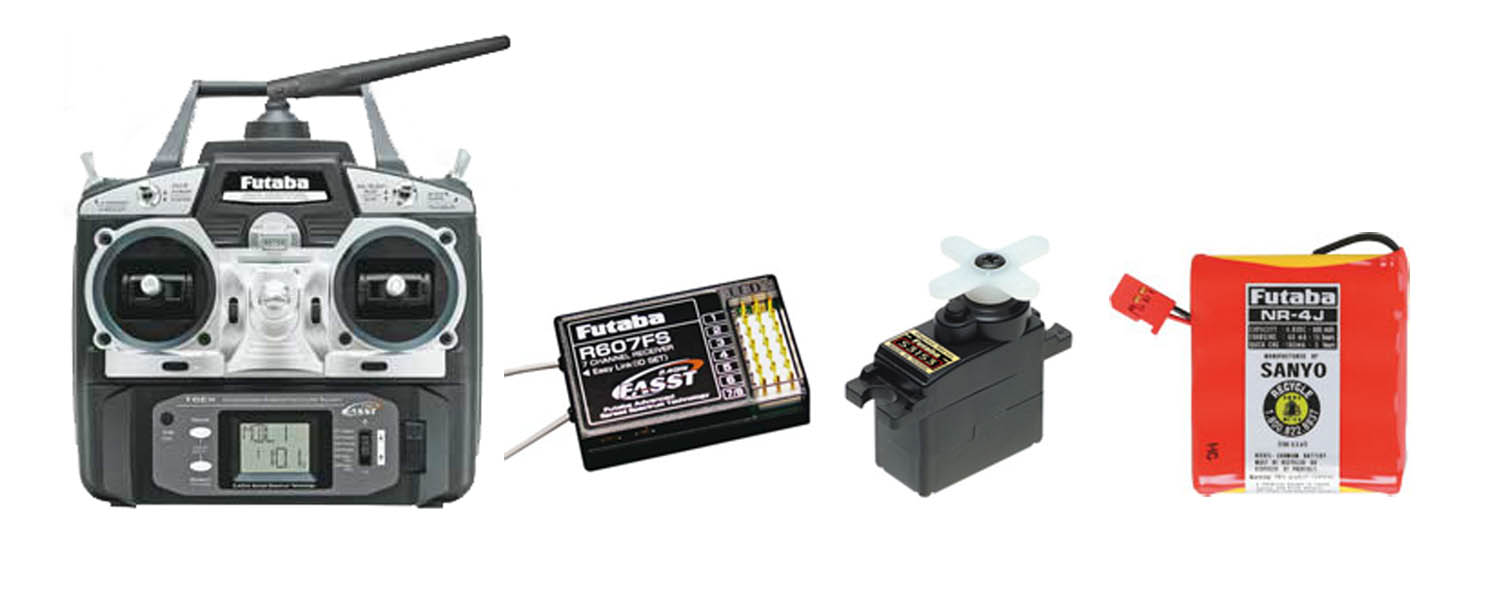
An RC airplane radio system consists of a transmitter, receiver, servos and a battery. If it's an electric powered plane it will also have an ESC.
|
Transmitter(Tx): -Hand held controller that sends the pilots inputs to the airplane. Receiver(Rx): - Electronic unit that rides in the aircraft. Receives signals from the transmitter and relays these signals to the servos. Servos: -Small proportional controlled gear motors that mechanically move the control surfaces on the airplane. Servos are plugged into the receiver where they receives input signals from the pilot. Batteries: -Both the receiver and the transmitter require a battery pack to operate. The battery packs usually consist NiCd (Nickel-Cadmium) or NiMH (Nickel-Metal Hydride) batteries. Electronic Speed Controller: - Plugs in to the throttle port of the receiver and controls the speed of the motor of an electric airplane. How RC Radios WorksThe transmitter converts the pilot's movements into a radio signal in a process called modulation. The transmitter then broadcasts this signal to the receiver. |
The receiver inside the airplane picks up this signal the same way the radio in your car picks up the local radio station. The receiver pulls the information from the radio waves and relays this information to each servo.
Each servo has a horn that is attached to its shaft. This horn is attached to a control surface, or engine throttle, via a push rod. The rotation of the horn translates into a linear movement at the control surfaces.
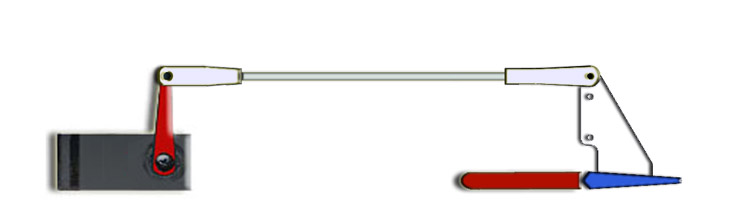
The movement of the servo is directly proportional to the movement of the control sticks on the transmitter. In other words, the control surfaces on the airplane move exactly the way you move the stick on the transmitter.
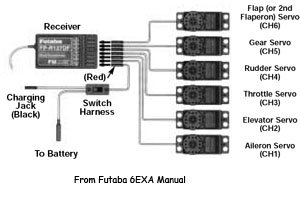
The servos and receiver battery simply plug into the receiver. Most people add a switch between the battery and receiver which is mounted to the side of the airplane.
The switch allows you to turn the receiver off without removing the battery when you're not flying. A switch with a charging harness allows you to charge the battery without removing it.
Signal Modulation and Frequencies
RC radio systems have evolved quite a bit over recent years which can lead to a lot of confusion for a beginner. Don't let the geeky details and jargon of radio transmission, modulation, frequencies intimidate you.
Spread Spectrum 2.4 GHz Radios
|
Spread Spectrum 2.4 Ghz RC radio systems are the latest and greatest technology. Basically the transmitter "locks on" to only one receiver in much the same way a wireless phone works with its base station. There are no crystals to worry about. You simply bind the receiver to the transmitter and you're ready to fly. |
 |
Not only are 2.4 GHz systems much simpler and safer to set up than older radio systems, there are a ton of other advantages with using 2.4 Ghz systems.
Older Radio Systems
|
If you plan to use a 2.4 GHz RC airplane radio system there is really no need to read continue reading this section, unless your curious of course. Keep in mind that you can find some great deals on top-of-the line FM radios on eBay simply because most folks have upgraded to 2.4 GHz. So this may be worth your time reading... |
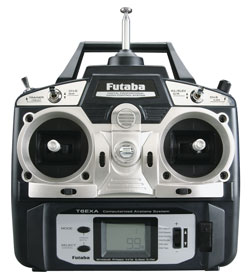 |
Amplitude Modulation(AM) - This technology is about as ancient as dinosaurs. But AM radios are still out there and still being used so it's worth mentioning. With AM, the radio signal is
switched on/off rapidly on a single frequency to modulate the input signal. AM is more prone to interference than frequency modulation.
Frequency Modulation(FM) -With FM, the carrier frequency switches between two different frequencies to modulate the PPM signal from the transmitter. FM is much less prone to interference than AM.
Pulse Code Modulation (PCM) -PCM is a digital form of FM. The transmitter basically sends the data to the receiver in binary code, which is "0's" and "1's" or "on" and "off". This is different from a standard FM(PPM) transmitter mentioned above which sends the signal to the receiver in a series of pulses.
*If this is clear as mud, take time to read about the differences between PPM and PCM.
Frequency Control
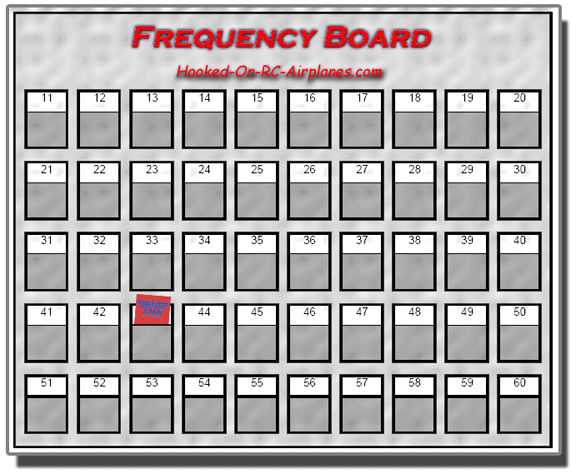
If you choose to use an AM or FM RC airplane radio system you have to be extremely careful not to transmit on the same frequency as someone else!
Two airplanes can not fly on the same frequency at the same time, at least not for very long! Every club has as system for keeping track of which frequencies are in use. Learn how clubs keep track of which RC airplane radio frequencies are being used at any given time.


RC Airplane Radio Controls
Now that you're familiar with what an RC radio does and how it works, it's time to talk about how you, the pilot, interact with the radio in order to fly your airplane.
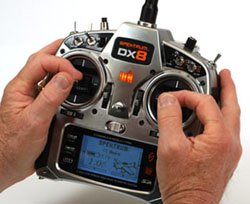
The next page, RC airplane controls, will get you up to speed on what a channel is, how many channels you need, and most importantly you will learn how to move the sticks in order to control your airplane.
One last note before I forget. Not all RC airplane radio transmitters have the sticks configured the same way. These different configurations are called transmitter modes. If you live in the U.S. it's a pretty safe bet your buddies at the flying field will be using mode 2.
Computerized Functions
Programmable radios not only make setting up your airplane a breeze, they also provide an entire range of features that maximize the performance of your airplane while making it much easier to fly.
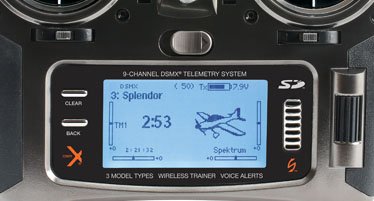
Without computer radios, the type of flying that many
pilots now enjoy would simply not be possible, especially 3D maneuvers. You can mix channels, set end points of servo throws, adjust exponential rates, set high/low rates, program out bad flying characteristics of your airplane and much more.
The sky is literally the limit when it comes to how you can use your computerized transmitter, no pun intended. It's all explained in detail in the article Computerized Radio Control Functions!
Have a Question about RC Radios or Components?
Have a question about a specific radio? What receiver to use? Servo questions? How to set up a radio? Binding problems? Anything radio related?
Whatever question or problem you may have, you can rest assured that someone has been in your shoes and will have just the information you're looking for. So Don't hesitate to ask!
Answers to Other Visitors Questions
Click below to see the RC radio questions and answers from other visitors to this page...
Airtronic Transmitter & Receiver Frequency Question 
I have two old Airtronic radio systems. These old radios were handed down to me. However, the sticker that shows the frequency of the transmitter has …
AR410 Spektrum Rx Hookup
How do I know which channel in an AR410 Spektrum Rx to plug in the various servos on my plane. I have an ESC, Ailerons, Rudder, Elevator = 4 channels. …
Spektrum AR610 Receiver
My AR9000/AR9020 have been sent to Horizon Hobby for repair.
The 9020 is brand new and the other about 6 months old. When binding both the satellites …
Receiver and transmitter compatibility
I am new to RC Flying. I recently acquired a J3 Cub 450.
I have a spektrum 6XDi Transmitter and a spektrum AR6100e receiver. They will not bind.
…
Spoilers with SPEKTRUM DX6
How do I get spoilers on my RC plane?
I mixed the “I” switch (Spektrum DX6) to Rudder (which is Ailerons on my left stick) so now when I push the “I …
T-28 Trojan S surfaces not working after binding.
I bought a T-28 Trojan S as a gift two years ago. It’s been on the shelf since and never opened. My grandson found it and asked if we could fly it. I …
Tactic anylink power
I want to use my "anylink" with my DX7.
Works fine but the extra battery to power the anylink is clunky and crude. Can I power it with the transmitter's …
Flysky FS-i6X to Hobbyzone T28
Hello,
New to the hobby with just a quick question. I ordered a Hobbyzone T28 trainer, which suggest using a spektrum transmitter. I already have a …
Futaba T9CAP Crystals
Have a old futaba T9CAP and trying to find a receiver with 75 MHz 39 or matching pair , does any body know where to find them?
receiver wont bind
HI GUYS AND GALS,I NEED HELP TRYING TO FIGURE OUT WHY MY SPECTRUM AR400 RECEIVER WONT BIND UP TO MY SPECTRUM DX6 DSMX RADIO.
I ASKED THE MAN IF THIS …
Linking & Binding Transmitter to Receivers
I have an impossible problem. 2 Futaba Transmitters and 1 Spektrum will not bind or link. All Transmitters indicate they are sending (1x Futaba T10CHG; …
Battery in a Radio transmitter
I am into Nitro easy going high wings mainly and my Trannie has given up after 30+ yrs.
I now want a 2.4 Mode1 and have picked a Futaba 6K.Now,having …
Old PCM "Airtronics Quantum"
The rudder servo will not operate properly.The others are okay. Is this a receiver problem?
Can a new receiver be used with the system. If the crystal …
problem with my new conscendo s powered glider
Hi from uk wherever you are??......ive recently bought a brand new conscendo s glider with a as3x receiver ...ive flown it three times and crashed …
RC Airplane Connections not Beeping
I have following connected ( all are brand new, and I am new to Flying, Complete newbie )
1. Tx = FS-i6
2. Rx = FS-iA6B ( also FS-iA6 came …
WIll old FS receivers work with new Taranis radio?
Will a FS-IA6, and FS_R6B receiver, work with the new FrSky ACCST Taranis Q X7 2.4GHz 16CH Transmitter?
looking for accessories for older Helicopters
Hello I have 2 helicopters that is making me pull my hair out looking for some parts for them.
One is a Dragon fly or schweizer 300 c heli that calls …
Question about RC Helicopter Frequencies
I have several helicopters and was wondering I bought another heli that has no transmitter.The frequency sticker on the heli says 27mhz and it is white. …
how to set up a seperate switch for a gyro so I can set up gain
Hi,I have a spectrum dx8 radio that I would like to be able to adjust the gain on the knob switch on this radio.The gyro I want to us the power box 3e …
Radio System Advice for My Old Planes
Thinking about getting back into the hobby and bring out my old planes ( kadet senior, p-47, pt-19, stuka, dr-8, etc.) my old radio system was/is futaba …
Mounting the receiver
What is the best way to mount the receiver in your plane? Mount to a wall or wrap in foam?
Homemade TX/RX System
I'm making a homemade rc P-51D Mustang, but I couldn't find any receivers small enough to fit inside.
Is there a tutorial on making a 5ch TX/RX system? …
Redundant Systems for RC Plane
I am in need of a redundant reciever battery combination. I can find no info on how to safely implement this.
I have heard of them being used in large …
Spektrum DX6 Discontinued?
Reading your comparison of dx7 dx6 and dx6i I was convinced I only needed the dx6i. However looking at other sites it appears the dx7 is discontinued …
RFI on 2.4 Ghz
I just bought a phantom I (2.4 ghz transmitter) and I have read that if you don't turn off your mounted hero3 wifi (2.4 Ghz) it can fly away because of …
RC Radio that works for all Brands?
Is there a radio that can handle all brands of planes?
Really sorry for this silly question. I'm new to this. I've been buying Parkzone and Hobby Zone …
Can I connect my battery to the bind/dat pin on my AR 400 rx
I have a nitro trainer 4 channel plane, where do I connect the battery on a 4 Channel RX ? I have an AR400 Spectrum, do I need a 5 channel RX?
My transmitter …
Servo for Remote Car Starter Throttle
I have a 1984 Towncar. I had a remote engine starter put on, but the engine will not start cold, unless you pump the pedal once to set up the throttle …
Only one Tx for two planes?
I bought a RTF-plane. You know it has everything you need, right? But, there are those "almost ready to fly" planes, where you need only to buy a TX. …
Question about receivers for DX6i TX..
Hello boys and girls....
I have a question..actually, I have a lot as I am newbie, but I'll keep it down to one.
I am using a Dx6i Spektrum Tx …
How to choose RC Plane Radio components Not rated yet
I have been out is RC Airplanes for 20 years and wish to get back into the hobby. I understand the concept of the new systems frequency hopping.
…
Range for Radio controlled payload drop system Not rated yet
I am trying to build a Payload drop system for my drone. I am going to use it to drop live bait out off the beach to about Maybe 1/4 of a mile out. Now, …
camber mix Not rated yet
I have a Great Planes Zlin Acrobat. Fun to fly but lands like a rocket. Has anyone had success with using camber mix for landing this airplane?
More articles about RC Airplane Radios...
- RC airplane Controls
- RC Airplane Frequencies
- Pulse Position Modulation(PPM)
- PPM vs PPM - Which is best for you?
- Spread Spectrum Radios-the wave of the future
- Spektrum RC Radio Systems
- Spektrum DX7 vs DX6i
- How to Fly RC Airplanes Successfully
- RC Telemetry
- Spektrum DX8
Home › Radio Basics
Let’s Go Flying! |
|
5 Steps for Successful First Flight! When the RC bug bites, it bites hard! Control yourself my friend! Save yourself much time and money by following these five steps to success! |


|
Follow us on: |
 |