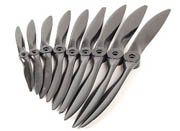
Model Airplane Propellers"Model airplane propellers come in The most important aspect of the propeller is the size. The shape and the material type determine how efficient the model airplane propeller will be. There is a range of propellers that are available or safe for a specific engine. However, it is important to realize that the propeller size is determined by the airplane and the pilot's flying style. You can't size the propeller based on the engine alone.
Sizing the Model Airplane PropellerThe manual for every engine will give you a range of propellers that are safe to use with that engine. The manual does not specify the exact size propeller because the propeller must be sized for the airplane that it is used with. It is very important to stay within this recommended range. You can also refer to Top Flight propeller selection chart below to determine the range of propeller sizes that are acceptable for your engine size. Keep in mind that the Top Flight chart is sized for 2-stroke engines. Consult the manual for 4-stroke propeller sizes because these engines produce more torque at slower speeds and will use a larger propeller. The propeller puts a “load” on the engine. If the load is too small or too large it will damage the engine. You must choose a propeller within the recommended range that best suits your airplane and your flying style.
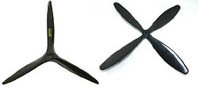
The characteristics of a propeller are defined by the diameter and the pitch. The diameter is the distance from one tip to the other. The pitch is defined as the distance the propeller would move the airplane forward in one rotation in a “perfect” world. Perfect world meaning that the propeller is 100% efficient and the air does not compress, neither of which is practical in the real world. The “twist” of the propeller is what determines the pitch. Basically the length of the propeller and its twist defines its characteristics. A model airplane propeller size is always referred as its Diameter x Pitch. A 11" diameter propeller with a 6" pitch is called a 11 X 6 propeller. Generally speaking, the larger the diameter of the propeller the more thrust will be produced by the engine. The larger the pitch the more speed you will get out of your engine. A small diameter large pitch propeller will move a small volume of air really fast! A large diameter small pitch propeller will move a large volume of air at a slower speed. Increasing either the pitch or the diameter puts a larger load on the engine. To keep the proper load on the engine you generally change the pitch and diameter together. For example, 9x7, 10x6, and 11x5 propellers would all put a very similar load on the engine. If you want to change the maximum RPM, then you need to change the load on the engine. Replacing a 11x6 prop with a 10x6 prop, or replacing a 11 X 6 prop with a 11 x 5 prop will decrease the load on the engine and raise the max RPM. Changing from a 10 x 6 to 10 x 7 prop, or changing from a 10 x 6 prop to a 11 x 6 prop will increase the load and lower the max RPM. If the propeller load is too large the engine will not turn fast enough to fly the airplane and could cause the engine to overheat. If the load is too small the engine will turn too fast damaging the engine. So it is important to stay within the window recommended by the engine manufacturer. It is also important to know that the engine must be tuned each time the propeller size is changed because of the change in load the engine sees. When choosing a model airplane propeller, you must keep in mind that you are choosing the propeller based on how you want the airplane to fly. This really has nothing to do with the engine other than the fact that you must stay within the recommended window of props to prevent damaging it. The same engine used on two different airplanes may be using completely different propellers. If you have an airplane with low drag designed for speed then you will want more pitch. If you have a slow airplane with a lot of drag, such as a bi-plane, you will want more diameter (thrust) and less pitch (speed). Choosing a propeller that best fits your airplane and your flying style is a trial and error process. Pick up several propellers within the recommended range. If your airplane seems too sluggish when taking off and accelerating then change to a lower pitch larger diameter prop. If your airplane has plenty of pep and you want to make it go faster then change to a larger pitch smaller diameter propeller. It's really lot of fun to experiment with different propellers and observe how the airplane reacts. Back to Top Multi-blade Model Airplane PropellersThree bladed model airplane propellers are less efficient than two bladed propellers. In fact, the more blades that are added, the less efficient the propeller becomes. The only advantage of a multi-blade prop is a smaller diameter.
Multi-blade propellers are used with full-scale airplanes when ground clearance is an issue. WWII fighter planes are a good example. For this reason many pilots use multi-blade props on their scale model airplanes to make it look more like the full-scale airplane.
Twin engine airplanes often use multi-blade propellers because the smaller diameter is needed for the propeller to clear the fuselage. This is true of full-scale airplanes and often the case with twin engine model airplanes as well.
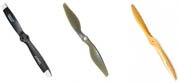
Evolution Engines offers a three-blade propeller to be used with a trainer. The inefficiency of the prop "tames" the engine a bit for the beginner by allowing the airplane to fly slower while maintaining the thrust needed for easy take-offs and climbs. This extra blade also helps to slow the airplane down when landing. After the beginner becomes comfortable flying the airplane he can tap into the rest of the engine's power by changing to a more efficient two-bladed propeller. Back to Top Model Airplane Propeller ConstructionThe efficiency of a model airplane propeller is determined by the shape of the propeller as well as the type of material it is constructed from. When the propeller bends and flexes, it decreases the efficiency. So the more rigid the propeller is, the more efficient it will be. Wooden and Carbon Fiber(CF) propellers are the most rigid and efficient. Most competition airplanes use wooden propellers for this reason. The three common types of model airplane propellers used at my club are wooden, Carbon-Reinforced Nylon (APC brand), and Fiberglass-reinforced Nylon (Master Airscrew Brand).
Out of these three,
the wooden propeller
The most common propeller used is the
APC propeller
The second most popular prop used at my club is
the Master Airscrew (Fiberglass-reinforced Nylon) propeller
Because of the difference in shapes between these model airplane propellers, the characteristics will vary slightly. A 11 X 6 of one brand may behave like a 11 x 7 of another brand. Keep this in mind if you decide to try a different brand. Back to Top Balancing the Model Airplane PropellerBalancing the model airplane propeller is very import for several reasons. The most important reason is that the violent forces from an unbalanced propeller will destroy your engine very quickly! An unbalanced prop could also cause excessive foaming in the fuel tank in addition to damaging the radio equipment. It is good practice to balance all of your props before taking them to the field. This way you don't have to mess with balancing the propeller when changing a prop at the airfield. It is always a good idea to remove any sharp edges from the propeller before balancing it.
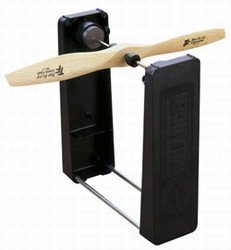
Many prop balancer tools are available.
Top Flight's magnetic balancer
The standard way to balance the propeller is to lightly sand the heavy side. It's not really important whether you sand the front or the back. But do not remove or sand the tip of the propeller because this will cause the propeller to be dynamically unbalanced even though it may be statically balanced. After sanding lightly check the balance again. If one side is still heavy you will need to remove a bit more material from the heavy side. Don't remove very much material at a time because you will end up chasing your tail! Repeat the process until the propeller balances horizontally.
Different Types of Prop Balancers on eBay Back to Top Installing the Propeller
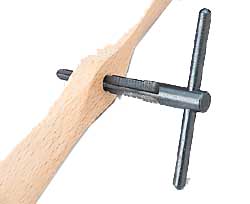
If the engine shaft is larger than the hole in the propeller than you must enlarge the hole. Either use a drill press or a
prop reamer
If you are using a spinner, the first step is to slide the spinner back plate on to the shaft. Then position the propeller horizontally on the shaft so that compression is felt when you try to rotate it. If the engine quits, the air passing by will rotate the propeller and the compression of the engine will hold it in this horizontal position. This will minimize the chance of breaking your propeller during a dead stick landing. Make sure the back-plate is in position before tightening the nut and locknut. Use a socket or adjustable wrench to snug both bolts down as tight as you can. Don't use a channel locks or pliers because you DON'T want to strip the nuts! The last step is to screw the spinner to the spinner back-plate. There should be slight space between the spinner and the prop blades. You may have to trim the spinner blade openings so that there is a small gap between the blades and the spinner. Back to Top Similar pages that may interest youBack to Top
Not what you're looking for?
|
| |||||||||||||||||
|
||||||||||||||||||