How Electric RC Airplanes Work
Today’s electric RC airplanes can do just about anything a nitro or gas powered plane can do.
In fact, many people have converted their glow powered airplanes to electric model airplanes.
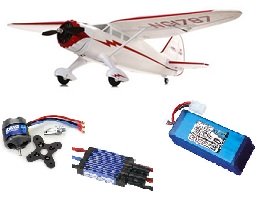
The beauty of flying electric is that there is never on oily mess to clean up when finished flying.
There is no need for carrying a gallon of fuel. With an electric plane, you simply charge the batteries and go fly!
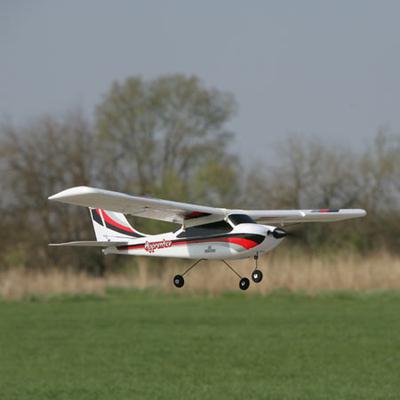
ParkflyersSmall electric airplanes are perfect for starting out in this hobby. I personally learned to fly with an electric park flyer. 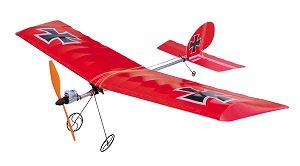 Park flyers are small electric airplanes that usually come with everything installed and ready to fly. |
RC electric airplanes are also quieter, safer, and can be flown in fields, parks, and other places where glow powered airplanes can’t (or shouldn't) be flown. I'll have to say though, there's one drawback that's hard for many of us to overcome... An electric motor just don't sound near as cool and a fuel burning engine! Let's discuss the different electrical components involved with flying electric airplanes. Be sure to follow the links to pages with more details on each. |
If you have a specific question about electric planes, don't hesitate to ask your question here!
Components of Electric RC Airplanes
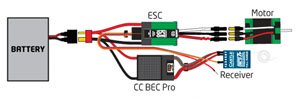
Image from Castle Creations
An electric RC plane has a motor, an electronic speed controller (ESC), and sometimes a gearbox. Of course, they all need batteries.
Electric RC Motors
|
There are two types or RC electric motors used with RC airplanes. The first type seen below is a "canned" motor. This is a standard DC motor with brushes. 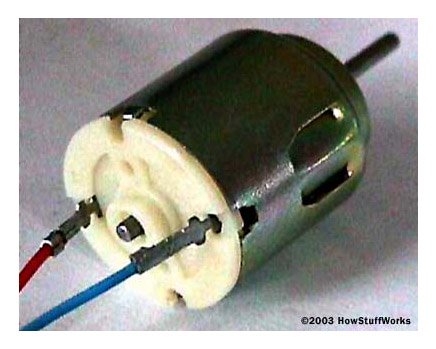 The second type of motor is a brushless RC motor. Brushless motors are much more efficient and lighter than canned motors. 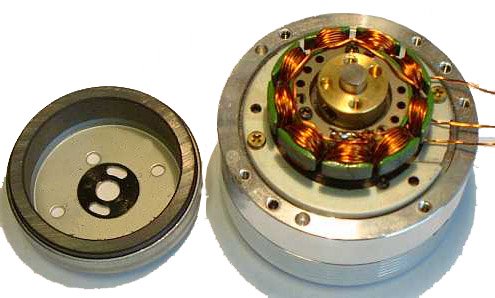 Not so long ago, if you wanted to fly large airplanes you had little choice but to use a glow engine or gas engine. That's not the case any more! Thanks to brushless motors, you can now fly any size RC aircraft without worrying about loud and messy engines. |
Brushless motors have revolutionized both ends of the spectrum. The increased power to weight ratio of brushless motors has also brought about an entire new breed of micro RC airplanes. Learn learn how brushless RC motors are so much more powerful than canned RC motors.
Electronic Speed Controllers
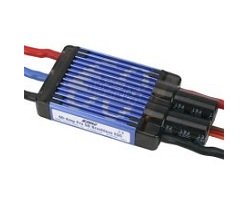 |
An electronic speed controller(ESC) is what controls the speed of the RC electric motor. The ESC plugs into the receiver. Both the motor and battery plugs to the ESC. As you move the throttle stick, the receiver tells the ESC to change the speed of the motor. |
Pretty simply right? Actually, there are a few key characteristics and options that you need to be familiar with to insure you choose the right ESC for your airplane. One of the most important things is knowing the difference between ESC's for brushed and brushless motors.
Learn more about Electronic Speed Controllers Here
Do You Need a Gearbox?
The speed at which an RC electric motor runs most efficiently is often much faster than we want the propeller to turn. This is especially true with brushless inrunner motors.
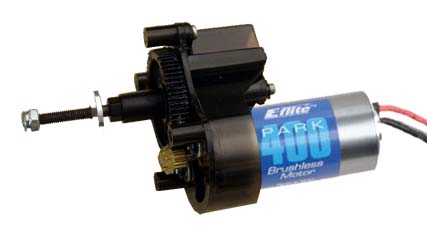
A small plastic gearbox between the motor and propeller reduces the output speed and increases the torque of the propeller shaft. This allows the airplane to use a larger propeller that produces more torque.

These gearboxes are really simple. They generally consist of a small pinion gear on the motor driving a larger gear on the output shaft. Gearboxes are most commonly used on small light weight parkflyer electric rc airplanes where minimizing weight is crucial.
Gearboxes are noisy, they reduce efficiency, and its an added part that can and does get damaged during a crash. Whenever possible, you're best bet is to use a slower higher torque outrunner motor that doesn't require a gearbox.
Types of Batteries
Obviously, the batteries are what supplies power to run the motor, receiver, and servos. The three types of batteries most commonly used with electric RC airplanes are Nickel Cadmium(NiCd), Nickel Metal Hydride (NiMH), and Lipo batteries.
But let's not fool ourselves, Lipo's are by far the most widely used these days. Not only with electric RC airplanes, but with most all electronics.
That being said, every type of battery needs to be charged differently and may require different chargers. Be sure to read the directions that come with your batteries carefully.
 |
NiCd batteries are commonly used for transmitters and receivers of both gas and electric RC airplanes. Many lower priced park flyers use this type of battery also. The main disadvantage of NiCd batteries is that they have a memory. In other words, the capacity diminishes if you do not fully discharge the battery after every use before recharging. |
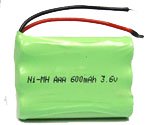 |
NiMH are similar to NiCd batteries and have less issues with “memory”. The capacity per weight is more than that of NiCd batteries. I replaced my receiver NiCd receiver batteries with NiMH batteries and they last about twice as long before having to be charged. |
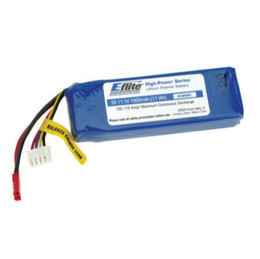 |
LiPo batteries are a quantum leap from the other two types of batteries. These batteries pack an enormous amount of energy and are much lighter than the other two types. LiPo batteries keep a constant power output throughout the flight where as NiCd and NiMH batteries slowly loose power until the battery is dead. |
Question about Electric Airplanes or Components?
Do you have a specific question about your electric RC airplane? Have question about component selection? What size battery to get? Problems getting it all to work right?
Don't hesitate to ask your question here. We'll do our best to help you find the answers you're looking for!
What Other Visitors Have Asked
Click below to see questions from other visitors to this page...
Dynam Waco problems 
This plane just won't fly. It came with a crooked vertical stabilizer and rudder. The horizontal stabilizer isn't the straightest either. I've reinforced …
What lipo battery should I use with a Rimfire 80 with a 15X8 prop?
Just installed a Rimfire 80 with a 15X8 prop in my Stinger 60. It weighs in at 9.5 lbs. This is my first electric set up and I replaced a well worn MDS …
Motor, prop, battery esc?.
I’ve been out of the RC flying for quite some time, I have a Lazy Bee with a 48 inch wing span, and the fuselage is 30 inches long, never flew it, but …
RC Electrical Components
I teach in a Makerspace in MA and I have a student who is interested in creating his own RC plane from scratch. We have a number of electronic components …
need electronics picks
Hi,
I'm building my first RC electric plane, I have the Tom-E-Boy 150 almost built and need the electronics for it.
Can you provide me with your …
Gas to Electric RC airplane converting.
I imagine you get this question a lot. My Goldberg Eagles 2 has a OS 46 gas engine. I Would like to convert it to a electric brushless motor. Would like …
Choosing Motor for RC Airplane
Hi, i was wondering how do i know i am getting the right motor-propeller-battery configuration for my model?
when choosing the electric motor, are …
Convert Free Flyer to Radio Control
First time converting free flyer to R/C so this language is confusing. Looking for type of motor and battery for lightweight R/C. This is what the kit …
From Super C S to Convergence VTOL
Hi my name is mason I am 13 and my dad told me to ask my question on here, I have a question about upgrading to a new plane. My question is... I fly a …
Converting Goldberg Anniversary J3 Cup to Electric
Hi, A friend gave me an old Goldberg kit for the J3 Cub. I have built the plane but can't figure out what servos, batteries, motor to use, although a few …
Spinner for Durafly 1100mm "Ferocious Frankie" P-51.
Anyone know where I can get a spinner for the Duraffly 43" P-51 "Ferocious Frankie" Mustang? I stripped out the base where the nut on the engine shaft …
Plug and Play Binding Question
You know when you get a plug & play elec plane, you bind the radio to the plane and then you have to deal with all of those settings. could you explain …
Using a Y splitter cable for LED's
Hi;
I'm new to flying and I bought a Hobby-zone Delta Ray. I am really enjoying flying this trainer and it's giving me a lot of confidence to move through …
Eflite umx pitts battery charger
I have this great flying plane, but now when I plug the charger to the battery, the charger blinks red and green all the time. This means it's balancing. …
Eflite Power 32 screams at high power settings
I have an Eflite Power 32 which has never been flown, but is a couple of years old. I installed it in a scratch built Cub and took it to the field to …
ESC 3.5mm Bullet male to EC3 female Connector Adapter
Anybody know where I can order a ESC 3.5mm Bullet male to EC3 female (and female to Male) Connector Adapter ?
Electric Motor Issue on Twin Engine Blimp
We are flying a twin engine electric blimp. Each engine is on its own channel mixed in the transmitter. Works perfect 99% of the time.
Occasionally …
What Motor for My Biplane?
I HAVE BUILT A BEA12A BIPLANE 49 INCH WINGSPAN AND I AM HOPING YOU CAN HELP ME CHOOSE A ELECTRIC MOTOR TO GIVE ENOUGH POWER TO FLY IT.
ALSO HOW DO I …
Receiver battery pack
Need a light receiver battery pack to run 4 micro-servos ( 4.8 to 6 volts) for 15 minute flights.
I am running an .049 glow plug engine and trying …
Airplane vs Multi Copter Propeller
I am a newer for RC Tech. I want to know , Can I use Multi copter propeller for Airplane(correct rotating side )? 'GWS 10x47 ' propellers for Multi copter …
NiMH battery packs in Tandem
Can NiMH battery packs be used in tandem, and if so how do you tie them together to use?
replace the motor on a flyzone switch
Trying to replace the stock motor on my flyzone switch to get more power. I have a 30 amp esc. What would be a good, more powerful replacement.
Servo cable orientation on Hobby King 6 channel RX
Using a Hobby King 6 ch receiver. The servo cables with the 3-wire RED / BLACK / WHITE wires seem to fit into the header on the receiver , either …
Electric Brushless Motor Won't Turn
I recently bought an ARF C182 from Lanyu.... I charged the batt, set up everything, and all is good, except that there is no rotation of the motor!
I …
ESC OVERHEATING
Hi,
I have a Bixler2 with a Hobbyking 2725 1600kv motor Max current 17A, Max power 190W swinging a 7x5 sports prop. I use a Haiyin 2200mAh lipo battery …
RC Airplane Control choice and flexibility
Here are some questions that I hope someone with more knowledge than me can answer. I recently got bitten by the RC ‘plane bug. The aerodynamics started …
Castle ESC Problems
I seem to have intermittent failures on launch when using the Castle Phoenix Edge ESC. Is this a common problem?
Battery for 50lb electric plane
I am putting together a plane that will be roughly 50lb and need to find a motor esc and battery pack to power it. I have to use NiMh batteries which is …
Unequal Lipo Batteries in Parrallel
If I plan on using 2 batteries in parallel do I need to use the same size batteries.
For example: can I use a 3s 2100 with a 3s 1300 to get 3400 mah? …
Horizon Hobby Sport Cub S Motor oscillating\pulsating
Hi - I have a Sport Cub S, just purchased. Actually received one from Horizon Hobby last week, but the elevator would not respond and the motor pulsated …
Soldering Lipo Battery Wire Back to Battery
Is it possible to replace or solder a battery wire back to the battery?
The wire that came off is the blue one that is used to charge battery.

RC Twin Electric Motors Spin Opposite?
When operating an plane with 2 motors is it permissible and or recommended to run one motor in one direction and the other in the opposite direction …
Battery Size for Twin Pusher
I have made a plane body twin boom pusher. The wing span is 90 cm. I have a 30 amp ESC, a 1045 prop with 1000 kv motor. My weight is 700 grams.
So …
Flyzone Cessna 182 Insufficient Power for Flight
Have an old Flyzone Cessna 182. Factory setup. Old batteries but they appear to be at appropriate voltage and holding charge with no load.
That's …

Batteries for Electric Twin Dornier Do 335
I am building an electric twin motor Dornier Do 335. I plan to use the same motor fore and aft. The manufacturer's suggested battery configuration is 5S5000x2 …
best gearbox available for high torque big prop Giant cargo plane
I am designing a heavy-lifter seaplane for use in disaster relief situations where supplies are desperately needed on devastated shorelines and long, hard …
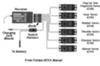
wiring the control system for an electric powered rc airplane
I need some help with wiring an electric RC airplane. I am a little confused with how we connect the motor to the speed controller then to the radio receiver. …
Electric Conversion Seagull 40 Not rated yet
Can you recommend an engine,speed controller and prop' for a Seagull 40 plane. The kit was originally intended for 32 to 46 two stroke IC
Motor esc prop packages Not rated yet
Do companies sell a power pack, for example if I had a park flyer that weighs 14 oz with no electronics and wanted to get the esc, motor, motor mount, …
Brian Taylor 81" electric powered Mosquito. Wiring Question Not rated yet
Hi
Iam in the process of building a Brian Taylor 81" electric powered Mosquito.
Was looking for a wiring diagram with contra turning props.
As well …
Volantex Trainstar Exchange Motor Problems Not rated yet
I have a Volantex Trainstar Exchange, and after a mild crash in the grass, the motor twitches and will not go. So I installed a brand new 1250kv motor …
Additional Reading...
If you found this page helpful, I highly recommend taking a look at these pages as well.
- Sizing RC Electric Motors
- Lipo Batteries
- Brushless Motors
- Electronic Speed Controllers
- Electric Park Flyers
Home › Electric RC Airplanes
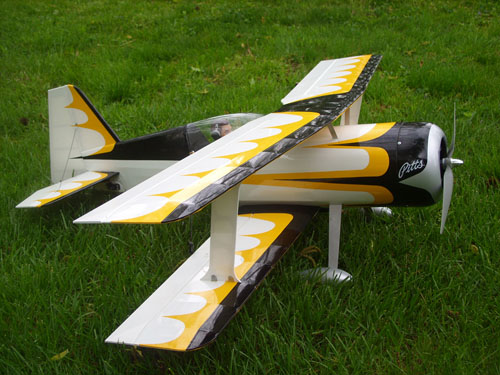
E-Flite Pitts
Let’s Go Flying! |
|
5 Steps for Successful First Flight! When the RC bug bites, it bites hard! Control yourself my friend! Save yourself much time and money by following these five steps to success! |

|
Follow us on: |
 |