RC Turbines
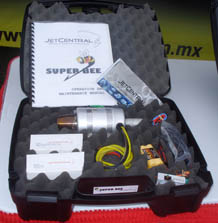
Genuine RC turbine powered jets look, sound, and fly exactly the same as full-scale jet fighters. If there is ever a turbine jet rally within driving distance of your home, you owe it to yourself to attend.
Before we get into the details of how jet turbines work, auxiliary equipment needed, and where to get one; take a second to watch the video I made from Jets of Kentucky.
RC jet turbines operate by the same principle as full-scale jet engines. Heck, they even use the same 'Jet A1' fuel!
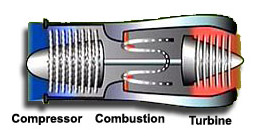
There are three sections of a turbine engine. There is the compressor, the combustion chamber, and the turbine.
The compressor compresses the incoming air. Because of this extreme compression, the air is heated up in the process. Heated and very high pressure air makes its way into the combustion chamber. The combustion chamber has a glow plug similar to the glow plug in a basic glow engine.
When the air in the combustion chamber reaches the appropriate temperature and pressure, a fine mist of fuel is introduced and the glow plug is lit. The fuel explodes pushing the exhaust gases through the turbine and eventually out the small nozzle at the rear of the jet. The high velocity of these exhaust gases is what produces the thrust to propel the jet.
The turbine and the compressor are connected to a common shaft. The exhaust gas from the combustion process turns the turbine which drives the compressor. In order to get this process started the turbine must initially be powered by an outside source until the air in the combustion chamber is at the right temperature and pressure.
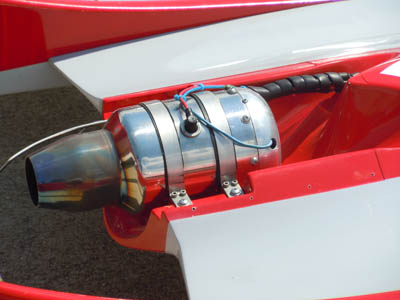
Spooling Her Up...
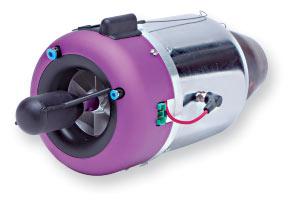
This Jetcat turbine has a small electric motor that spools the engine up to obtain the proper temperature and pressure before fueling and igniting can take place.
The entire starting sequence is controlled by the ECU (Engine Control Unit), which is the computer that controls the fuel valves and ignition system. Once the turbine is lit and running the computer turns the controls over to the transmitter.
Ground Support Unit


.)
Most RC turbines have a Ground Support Unit (GSU). The GSU is a terminal for programming the turbine's parameters as well as monitoring the engine's performance. The GSU makes it possible to adjust the turbine's parameters in real time while the engine is running. The GSU can be connected or disconnected at any time without affecting the engine.
The GSU connects to the ECU through an LED board. The LED board indicates what function the ECU is performing while spooling up and starting the engine.
Purchasing an RC Turbine Engine
RC turbine engines are by far the most extreme aspect of this hobby! However, these engines are very expensive and even more dangerous. It takes years of practice and dedication to acquire the necessary skills and confidence to fly a turbine powered jet.
These turbines, along with the sophisticated electronics needed to run them, will set you back several thousand dollars. And that's just for the engine, not counting the cost of the aircraft. So you had better be pretty darn confident in your flying abilities before putting that much money on the line!

Here are some places where you can buy a gas turbine engine when you are ready. Make sure you are setting down before looking at the prices!
Jetcat RC turbines are probably the most popular and arguably the best RC turbine engines on the market. If you're serious about purchasing a turbine engine, your best bet is to visit BMV Jets.
The president of BMV, Bob Violett, has spent his entire life designing and manufacturing RC jets and equipment. BMV Jets also sells Jetcat turbine engines. They can help you select both your aircraft and the power plant.
Jet Central is another well know manufacturer of quality RC gas turbine engines. They are direct competitors of Jetcat.
The Gas Turbine Builders Association in the UK has an excellent website with tons of information on model gas turbine design and history. This organization helped to improve the design of the Kamps Micro turbine engine.
|
This video shows a Jetcat turbine engine spooling up and running on a test bench. This video will give you a good idea of all the equipment needed to run one of these bad boys.
| ||
More jet related pages...
Let’s Go Flying! |
|
5 Steps for Successful First Flight! When the RC bug bites, it bites hard! Control yourself my friend! Save yourself much time and money by following these five steps to success! |


Ducted Fan Jets
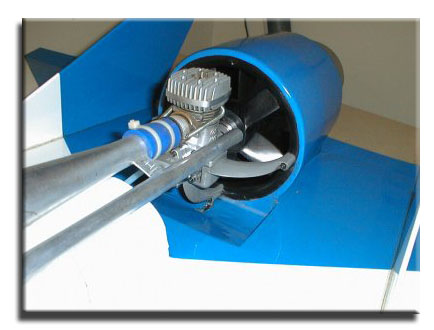
Ducted Fans -Affordable Alternative to Turbines
Popular EDF's

|
Follow us on: |
 |