Slope Gliders
When the wind is driving directly into a ridge or hill, it really has no place to go but up. Slope gliders harness the energy of the rising air to stay afloat.
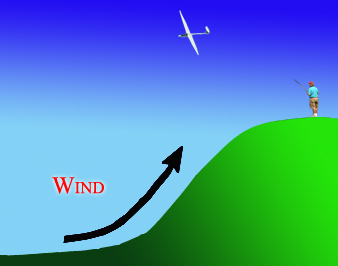
The next time you're out on a Sunday drive, take a look at the birds gliding around the sky effortlessly along the side of a ridge.
We actually stole the idea from them!
Ideally, you want to have the wind blowing directly into the ridge. An angle of more than 30 degrees between the wind direction and the face of the hill will not produce enough lift for your slope glider.
The wind speed and direction along with the shape and size of the hill determines how much lift is produced. The right slope with pefect conditions can have updrafts of several hundred feet from the top of the ridge!
If you're just starting out in the hobby, you'll first need to get comfortable with the controls of your glider. It takes some time to get the hang of the control inputs, orientation, and basic overall control of the glider.
Learning the sticks is much easier with slope soaring than other types of soaring. The flight times are much longer and the lift is much stronger and more uniform than lets say thermal soaring. This gives you more time to focus on controlling your glider rather than searching for thermals to keep your bird aloft.
Another advantage to the beginner is the fact that slope soaring doesn't require any type of launching equipment.
Types of RC Slope Soaring
- Aerobatic Slope Gliders - Aerobatic slope soaring is
what most people enjoy. Because of the increased maneuverability, these
types of gliders normally use ailerons for turning as opposed to rudder.
Because more weight is more speed, these types of gliders tend to be a
bit heavier than thermal gliders.
- Combat Slope Gliders - Combat soaring is where
multiple pilots try to knock each other out of the sky! So you can
imagine combat gliders need to be very agile, so ailerons are used for
turning. Because of the fatality rate, combat gliders are generally very
cheaply constructed and many times homemade.
You'll also notice that most combat gliders are of the "flying wing" configuration. This is because there are less parts making them more difficult to knock out of the air and more repairable in the field.
- Ridge racing - Ridge Racing is where multiple
gliders race along the lift of a slope. Some races involve multiple
gliders racing at the same time. Another type of racing is where each
glider completes the course individually while being timed.
Racing gliders also tend to have ailerons as primary control. The best racing gliders are specifically designed to produce the most speed with the least altitude drop.
- Dynamic soaring - What I have explained at the
top of the page is traditional slope soaring where slope gliders utilize
the ridge lift on the front side of the hill. Back in the old days
folks used to avoid the back side of the hill like the plague, it was
considered the "Dark Side"!
The extreme daredevils if you will, discovered how to harness the energy on the "Dark Side" for attaining unbelievably high speeds. Speeds nearing 400 mph! This type of gliding is called dynamic soaring.
- Powered Slope Gliders - Some people may consider it "cheating", but having a motor on the front of your glider can save you a lot
of walking! Whether you're slope soaring or thermal soaring there is
always going to be a time where you can find lift and a motor sure comes
in handy...
Powered gliders most always have props that fold back when not in use. A regular non-folding propeller will slow your glider down in a hurry!
Choosing the Right Slope Glider
When it comes to slope gliding, there is no "one size fits all" model to recommend.
Think about the type of gliding you would like to pursue. Do you want a fast glider? Rather have a floater? What are the lift conditions? Do you a perfect slope with tons of wind and lift? Does your flying site have mediocre lift?
Once you answer these questions you will be in a much better position to choose a slope glider suitable for you by understanding the following basics principles.
- Wingspan - In general, the wider the wingspan the more lift will be produced for any given airspeed.
- Wing Loading - Wing loading is the total weight
of your glider dividing by the surface area of the wings. The higher the
wing loading, the faster the glider must move to maintain lift.
- Airfoil - The airfoil is the shape of the cross section of the wing. Fully aerobatic gliders will tend to have fully symmetrical airfoils where as stable floating type gliders tend to have flat bottom airfoils.
The infamous "Gentle Lady"
If you're new to RC, you literally can't go wrong with the Carl Goldberg Gentle Lady. This is a two channel elevator-rudder floater that has been introducing new folks to the hobby since the 1970's!
Since Great Planes purchased Carl Goldberg, it's now the "Great Planes Goldberg Gentle Lady." This is a very easy build, even if you have no prior building experience.
The Gently Lady is very SLOW and doesn't require a lot of lift. It all actuality it makes a better thermal soarer than a slope glider because it can't handle too much wind. But it's absolutely perfect for a beginner to learn slope soaring in a light breeze.
Ebay has a Wide Variety of Gliders
There are many gliders that are designed specifically for slope soaring. Others are designed to be used with both thermal and slope soaring.
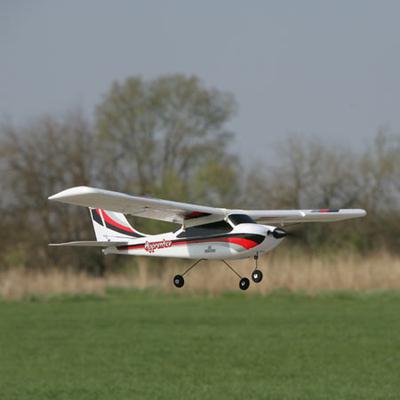
Because slope soaring doesn't require an extremely light model, an electric park flyer can actually make great slope gliders.
Again, consider what type of gliding you would like to do along with the typical wind conditions at your flying area.
More Info about Gliders
Home > RC Gliders > Slope Gliding
Let’s Go Flying! |
|
5 Steps for Successful First Flight! When the RC bug bites, it bites hard! Control yourself my friend! Save yourself much time and money by following these five steps to success! |
|
Follow us on: |
 |
 |