RC Pattern Planes
Pattern planes are RC airplanes specifically designed to execute aerobatic manuevers. A "true pattern ship" will have very little self-correcting characteristics. In other words, they pretty much stay where they're put...
The National Society of Radio Control Aerobatics (NSRA) is the governing body for Pattern-Style Precision Aerobatics in the United States. The NSRCA requires that airplane's fuselage and wingspan both be less than 2 meters and have a total weight no greater than 11lbs.
These vague requirements encompass a very wide variety of RC airplanes which makes it very easy and affordable for most anyone to get started in entry level precision aerobatic competitions.
Don't break the bank getting started!
If you're just learning to play golf, would you go out and buy the most expensive state-of-the-art clubs available?
Probably not, unless you have more money than sense...
If you're Tiger Woods on the other hand, you definitely want the best set of clubs possible to get any advantage you can over your opponents!
This same logic applies for choosing your first "pattern plane". All you need is an airplane that can perform the most basic maneuvers such as loops, rolls, stall turns etc.
If you've been flying long enough to move up from a basic trainer, there's a good chance you already own a plane that is perfectly suitable for practicing basic precision aerobatics.
Most 40 to 60 sizes RC sport planes or scale planes will suffice. You want to try to keep within the NSRCA specs stated above, but most CD's (Contest Directors) will allow you to compete at classman level even if your plane is slightly over-sized.
True "top-of-the-line" Pattern Ships
At higher levels of competition you will see what some consider "True Pattern Ships". These RC airplanes are specifically designed for perfecting precision aerobatic maneuvers.
Since larger planes fly better, these planes are usually a full 2 meters long with a slightly shorter wingspan.
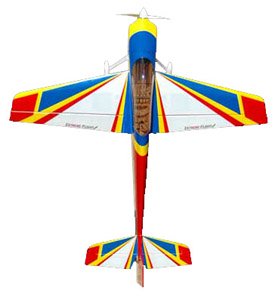
They have an unusually long tail moment that gives them the ability to fly aerobatic maneuvers much more precisely and cleaner than a scale RC airplane.
In other words, because of design restraints it wouldn't be practical to build a full scale version of these planes. They only exist in the world of model aviation. Their unique design is really what distinguishes pattern competitions from IMAC or scale competitions.
F3A Pattern Plane Manufacturers
Below are some of the high end popular pattern airplane manufacturers will give you a good idea of what a top-of-the-line ship is, and how much a nice one costs!
|
|
Learn more about radio controlled aerobatics...
Home > RC Aerobatics > Pattern Planes
Let’s Go Flying! |
|
5 Steps for Successful First Flight! When the RC bug bites, it bites hard! Control yourself my friend! Save yourself much time and money by following these five steps to success! |

|
Follow us on: |
 |
 |