Parts of an Airplane
Knowing the different parts of an airplane is obviously the first step in learning how to fly RC airplanes. Keep this page open as a reference while reading about how airplanes fly.
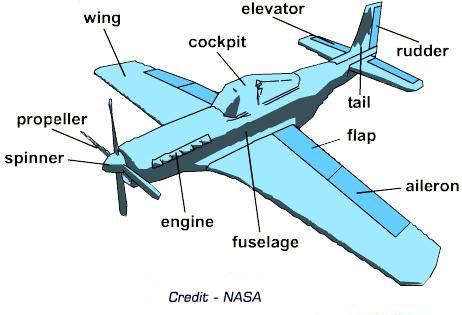 |
Fuselage - The body of the airplane. The wings, tail, and engine are attached to the fuselage.
Wing - I'm sure you know what a wing is. It's the horizontal airfoil that produces lift. The ailerons and flaps are hinged to the wing.
Ailerons
- hinged surfaces on the outside of the wing that swing up and down. While the
right aileron hinges up, the left aileron hinges down. And vice versa. These surfaces
control the roll of the airplane.
Tail - The rear section of the plane that consists of a horizontal stabilizer and a vertical stabilizer. The elevator hinges to the horizontal stabilizer. The rudder hinges to the vertical stabilizer.
Elevator
- hinged surfaces on the horizontal part of the tail that swings up and down.
These surfaces control the pitch of the airplane.
Rudder
- hinged surface on the vertical part of the tail that swings left and right.
This surface controls the yaw of the airplane.
Flaps - hinged surfaces on the wing just inside the ailerons. The flaps hinge down to
increase lift on take off and landing.
Engine
- Provides the power to turn the propeller to produce thrust for sustaining
flight.
Propeller
- A turning blade or twisted airfoil that produces thrust when powered by the
engine.
Spinner
- The nose cone that covers the hub of the propeller. Helps smooth the airflow
over the engine. Is where you place the electric starter on an RC airplane.
Cockpit - where the pilot sits while flying the plane. Houses all the controls and instrumentation.
Learn how airplanes fly...
Home > How to Fly RC Airplanes > Parts of an Airplane
|
Follow us on: |
 |
 |